10 g to 250 g planning range

Small-dose weigh filling for 10 g to 250 g packs.

A practical selection guide for low target weights where feeder cut-off, product behaviour, weighing resolution and clean transfer into the real pack matter more than the number printed on a machine range.

Treat the target band as a trial brief, not a guaranteed machine specification.

Small-dose weigh filling can suit seeds, coffee, grains, granules, sweets, hardware pieces and some free-flowing powders, but the target weight alone does not determine the correct machine. A 25 g dose of large irregular pieces behaves very differently from 25 g of fine crystals or an aerated powder.

The useful comparison is between the smallest repeatable increment the feeder can deliver, the product already travelling when feed slows or stops, the load-cell signal stability and the ability to transfer the complete weighed dose without loss, bounce or residue. Pack-mouth width, static, dust and operator presentation can dominate the result at low weights.

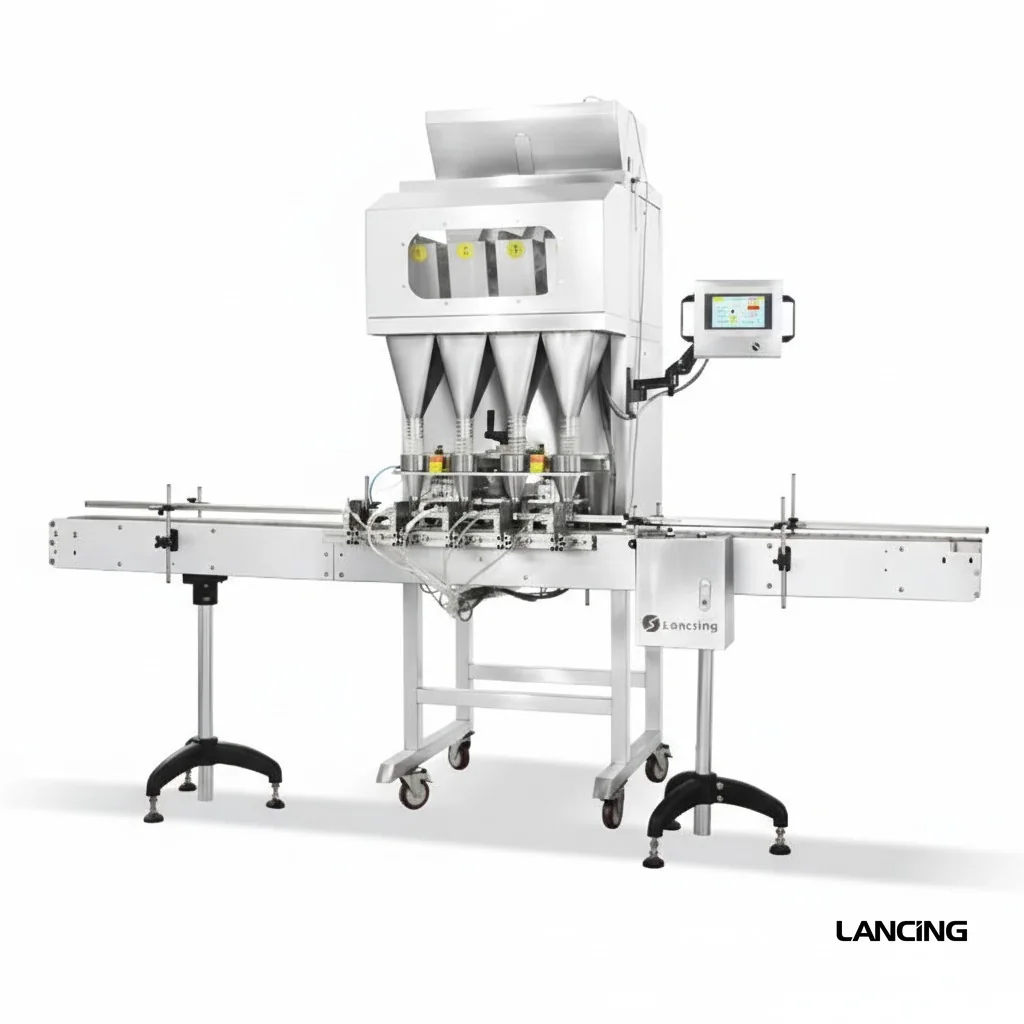
Stainless steel vibratory linear weigh filler used as a reference for small-dose dry-product filling

Specification checks

  • Supply the smallest, routine and largest target weights rather than one nominal dose.
  • Describe particle size, fines, fragility, static, dust, moisture sensitivity and batch variation.
  • Use production-quality pouches, sachets, jars or tubs during the trial.
  • Agree how net weight, tare, mean, variation and low results will be recorded.
Machine route

Which weigh filling route is most likely to suit a small dose?

Use product and pack evidence to choose the route before comparing individual machine configurations.

Linear or vibratory weighing

Often the first route to assess for free-flowing granules and regular pieces. Coarse and fine feed stages can approach the target progressively, but the feeder must be able to deliver a final increment that is small enough for the agreed tolerance.

Multihead combination weighing

Useful when irregular pieces, product fragility or higher accepted output justify several partial weights being combined. The product must distribute consistently across the heads and the pack or bagging machine must be ready for each discharge.

Auger dosing

A specialist option for cohesive or fine powders that do not move predictably under vibration. Powder behaviour, screw geometry, agitation, dust control and container presentation require a representative trial.

Counting rather than weighing

Potentially more suitable where the commercial requirement is an exact piece count and individual component mass varies enough that weight cannot reliably represent quantity.

Selection factors

What limits accuracy at 10 g to 250 g?

Test the factors that can change a stable laboratory result into an unstable production cycle.

Feeder cut-off and product in flight

Material continues to move after the control changes from bulk feed to fine feed or stops the feeder. The in-flight quantity must be stable enough for the controller to compensate without chasing individual fills.

Load-cell resolution and mechanical isolation

The weighing assembly needs a stable zero and must be isolated from pack contact, cable strain, vibration and retained product. A high display resolution does not by itself prove useful process resolution.

Product-to-dose relationship

A dose containing only a few large pieces can change in large steps. A fine but static-prone product may cling to the feeder or outlet. Both can produce variation for different reasons.

Discharge and pack capture

At low target weights, a small spill or retained amount can be a large percentage of the dose. The outlet, funnel, pack mouth and support height should be tested as one transfer path.

Verified references

Reference routes already documented on this site.

These are conditional first-party reference points, not universal promises. Final suitability depends on the representative product, pack and agreed acceptance method.

RouteHow to use the reference
LU-999 compact vibratory routeReference weighing range 10–999 g; published output reference 6–15 bags/minute and approximately ±2 g under referenced conditions. Product volume, flow and pack handling still require a trial. Open the supporting page
LU-3000C semi-automatic routeReference weighing range 20–3000 g with operator-presented packs and foot-pedal discharge. The sustained result includes opening, presenting and removing the pack. Open the supporting page
LU-GFKL420 automatic VFFS routeTen-head reference configuration with a 10–2500 g weighing range. Published speed and accuracy references are conditional on product, film, bag length, sealing and the complete line cycle. Open the supporting page
Acceptance evidence

Prove the small-dose result with consecutive finished packs.

Set the trial around the real product batch, target weight, pack, outlet and operating rate. Record consecutive net weights rather than selecting the best fills. Note every adjustment, refill, spill, incomplete discharge and pack-handling interruption.

Review mean weight, sample standard deviation, minimum, maximum, range and any result outside the agreed band. Keep process capability, commercial giveaway and any applicable packaged-goods assessment as separate questions. A reference scale, tare method and acceptance rule should be agreed before the trial starts.

Information needed for a useful quotation.

  • Representative product sample with normal fines and broken pieces.
  • Target range from the smallest to the largest planned pack.
  • Required tolerance and how acceptance will be judged.
  • Actual pack dimensions, mouth opening and presentation method.
  • Required accepted packs per minute or hour.
  • Cleaning, allergen, dust or cross-contamination requirements.
  • Downstream sealing, coding, checkweighing or conveying scope.