
Open and support the pack.
The pack mouth must clear the outlet without touching or loading the weighing assembly. Flexible pouches may need a repeatable grip or support position.
A compact vibratory weight filling route for an operator holding a pouch, bag or suitable container beneath the discharge and initiating the measured dose by foot pedal.
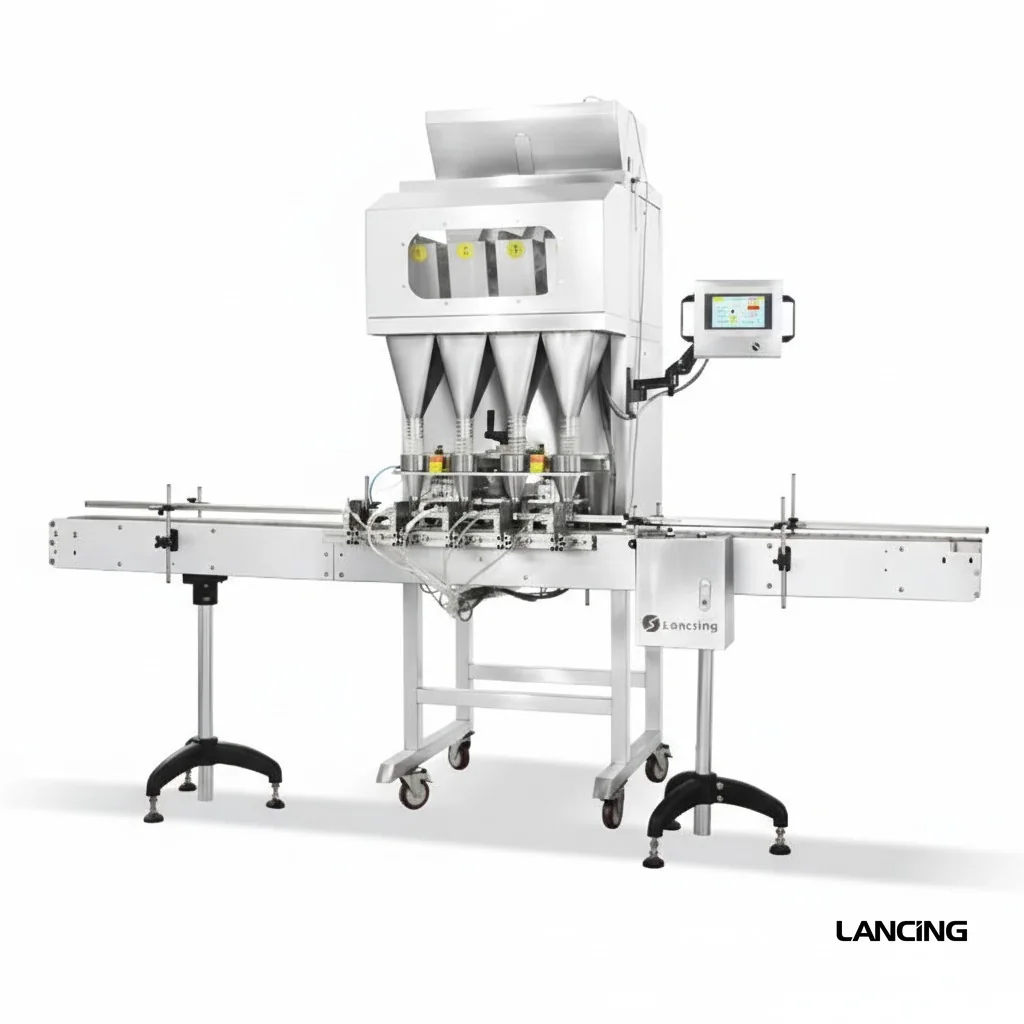
The LU-3000C reference is intended for flexible, lower-output work where an operator presents each pack and controls the discharge cycle. It can suit free-flowing dry materials when the product remains stable on the feeder and clears the outlet cleanly.
The headline weight range does not by itself prove suitability. A light, bulky product can occupy more volume than a dense product at the same weight, while static, dust, bridging or irregular pieces can change the way material reaches and leaves the weighing chamber.
| Reference weighing range | 20–3000 g. |
|---|---|
| Published output reference | Approximately 6–15 fills/minute, dependent on product, target weight, pack presentation and operator handling. |
| Accuracy position | Tolerance must be confirmed by a representative product and pack trial; no universal result is assumed. |
| Operating method | Operator presents the pack and initiates discharge using the foot pedal. |
| Product boundary | Free-flowing dry products that can be controlled by vibratory feeding, subject to sample approval. |
| Pack boundary | Pouches, bags, jars, pots or other suitable containers that can be supported safely beneath the discharge. |
For a semi-automatic machine, the operator and pack are part of the measured production cycle. A realistic trial therefore includes every handling step rather than timing the weigh discharge alone.
The pack mouth must clear the outlet without touching or loading the weighing assembly. Flexible pouches may need a repeatable grip or support position.
Vibratory feed approaches the target under electronic weight control. Stable product depth and a consistent hopper level help the machine repeat the feed profile.
The foot pedal releases the dose. The operator then removes the pack, checks for spill or retained product and presents the next pack.
This route can be appropriate for short runs, several products, development work, seasonal demand or a production step where an operator is already present. It may also reduce the initial handling complexity for packs that are difficult to feed automatically.
A dual-head machine can increase available weighing capacity or alternate feeds for suitable products. Automatic pouch handling or VFFS may be justified when sustained output and reduced manual handling are required. Cohesive powders may need an auger rather than vibratory feed.
Start with the smallest, routine and largest target weights. Record the product condition, hopper level, feed settings, actual net weight and any interruption or adjustment. Include at least one hopper refill and enough consecutive fills to reveal drift or an unstable feed pattern.
For each trial block, calculate the mean, sample standard deviation, minimum, maximum and any result outside the agreed acceptance band. A useful test also records spill, residue in the outlet, pack-mouth contamination and the time needed to present and remove each pack.
The final acceptance method should state the reference scale, tare procedure, product batch, pack, operator duties and whether output means machine discharges or accepted finished packs.
Lancing can review product flow, pack handling, target range and the required acceptance test before the final machine configuration is agreed.
No. The reference range is a weight boundary, not a guarantee of product volume or flow. The product must fit the weighing path, feed consistently and clear the discharge into the real pack.
The quoted reference depends on pack handling. Acceptance should therefore use sustained finished-pack output with normal operator presentation, removal and product refill.
Only a sample trial can confirm that the required product volume fits the hopper and weighing path. A low-density product can exceed the available volume even when the target weight is within range.
Vibratory feeding is strongest with products that flow predictably. Cohesive, aerated or bridging powder may require an auger or another controlled-feed method.
A documented consecutive-fill test using the intended product, pack, target, reference scale, tare method and operator cycle.