
Keep product depth comparable.
Uneven hopper level or different product condition can make one channel consistently faster or less stable than the other. Refill method should be part of the trial.
A semi-automatic dual-channel vibratory weighing route for free-flowing dry products, using two product hoppers and a common discharge into an operator-presented pouch, bag or suitable container.
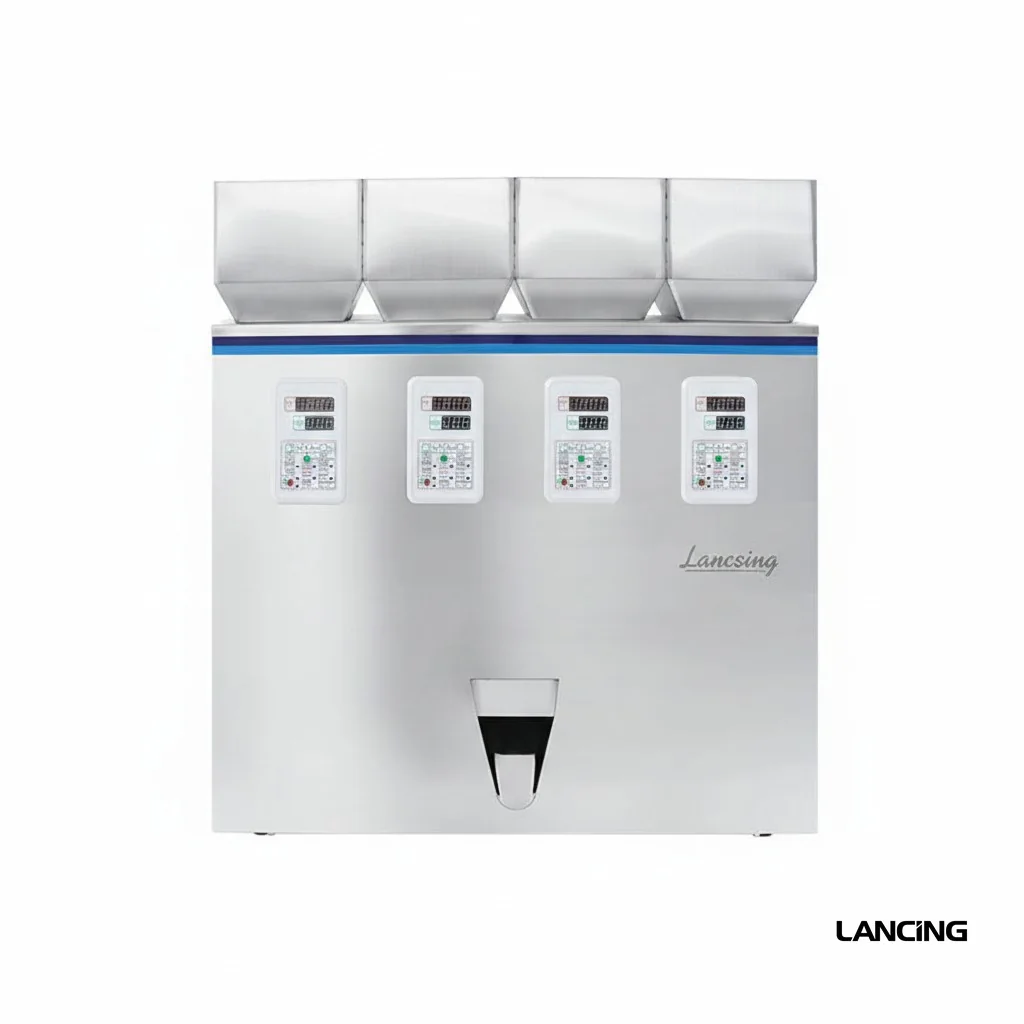
The LU-DL5000D reference provides two hoppers and two vibratory weighing channels with a common discharge. It is intended as a higher-capacity semi-automatic route for suitable free-flowing grains, seeds, crystals and small granules.
Dual channels do not automatically double accepted output. The complete result still depends on product refill, target weight, pack opening, operator presentation, discharge clearance and downstream sealing or removal.
| Reference weighing range | 100–10,000 g. |
|---|---|
| Published output reference | Approximately 20–30 bags/minute, dependent on product, target weight and operator handling. |
| Supplier accuracy reference | Approximately 2–6 g, dependent on the product and operating conditions; confirmation requires a representative trial. |
| Reference hoppers | Two hoppers of approximately 25 litres each. |
| Reference power | Approximately 460 W; final UK electrical requirements must match the quotation and supplied build. |
| Reference machine size | Approximately 720 × 700 × 1370 mm. |
| Reference product basis | Free-flowing, non-sticky grains, seeds, crystals and small granules, subject to sample approval. |
Each channel needs stable product feed and a clear relationship with the pack position. A bottleneck at the common outlet or in the operator cycle can remove the theoretical benefit of the second head.
Uneven hopper level or different product condition can make one channel consistently faster or less stable than the other. Refill method should be part of the trial.
Zero, mechanical isolation and reference-weight checks should be completed for both channels before a combined production trial.
The complete dose must clear the shared discharge without collision, overlap, residue or product bounce outside the pack.
The 100–10,000 g reference spans materially different product volumes and operator demands. A dense 10 kg product may present a different discharge and pack-support problem from a bulky product at a much lower weight.
A single-head machine may be more appropriate for lower output or frequent low-volume changeovers. A multihead combination weigher may handle irregular pieces more effectively where high output and combination accuracy justify the system. Fully automatic bag handling can remove the operator-presented pack bottleneck.
Begin by confirming that each weighing channel returns to a stable zero and is free from product contact, cable strain and mechanical interference. Use the agreed reference-weight procedure for each head. Then run consecutive production fills with the normal product, hopper-refill pattern and operator cycle.
Record which head or sequence produced each result where the control system makes that information available. Calculate the mean, sample standard deviation, minimum, maximum, range and any result outside the agreed band. Also record spill, retained product, incomplete discharge and manual intervention.
Output should be stated as accepted finished packs per minute over a sustained period. A short burst of discharges without pack replacement, refill and downstream handling is not a complete production measure.
Lancing can assess product behaviour, pack handling, operator duties and the required evidence before the final LU-DL5000D configuration is quoted.
Not automatically. The accepted output remains dependent on product feed, target weight, common discharge, operator pack presentation, hopper refill and downstream closing.
No. It is a supplier reference dependent on the product and conditions. The agreed result must be demonstrated with representative product and a documented consecutive-fill method.
The reference basis is free-flowing, non-sticky dry product. Sticky, cohesive or smeared material may need a different feed method and must be assessed from samples.
A combined result can hide a mechanical, zero or flow problem on one channel. Individual checks make diagnosis and maintenance more reliable.
Weight, volume, product flow, discharge clearance, bag support and operator handling all matter. A target within 10 kg is not automatically suitable.