
The receiving machine can accept a dose.
Bag maker ready should represent a valid bag position, available sealing cycle and no fault that would make a product discharge unsafe or wasteful.
A practical signal and sequence guide for synchronising a weigher with a bag maker, product infeed, coding, inspection and downstream equipment.
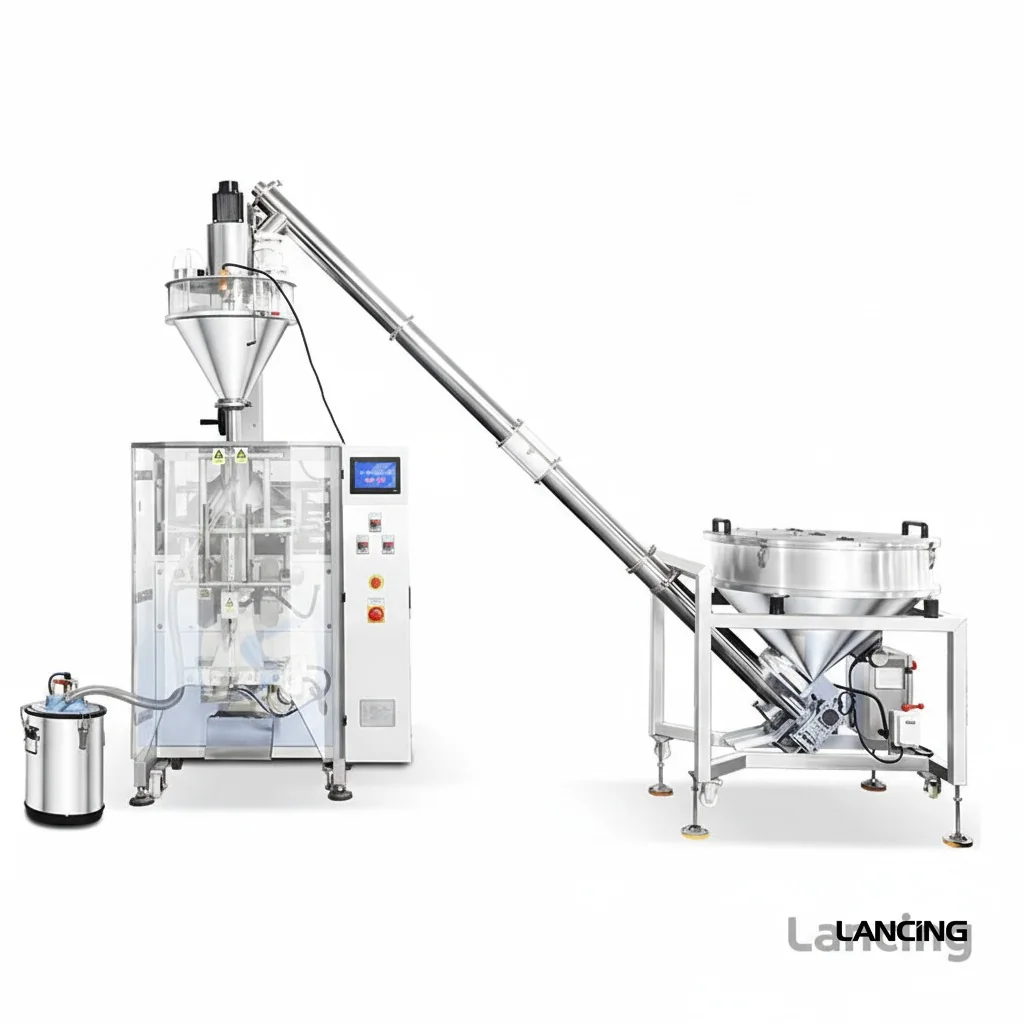
A weigh filler can reach its target while the bag maker is still forming film, waiting for a code, clearing a fault or blocked by downstream equipment. A defined handshake holds the measured dose until the receiving system is ready, then confirms that the discharge and bag cycle have completed.
The final signal list depends on the controls architecture and risk assessment. The sequence below is a functional planning framework, not a substitute for the machine electrical design, safety validation or software specification.
Signal names vary between controls systems. What matters is that both machines share the same meaning, sequence and fault response.
Bag maker ready should represent a valid bag position, available sealing cycle and no fault that would make a product discharge unsafe or wasteful.
The request identifies when a dose is needed; discharge permission confirms that the line state still allows release.
Discharge complete, bag-cycle complete and any reject or inspection state should be associated with the correct pack before the next request is accepted.
| Weigher ready | Weighing system available, no blocking fault and able to prepare or hold the next dose. |
|---|---|
| Dose ready | Target dose complete and held for release. |
| Bag maker ready | A valid bag position is available and the receiving sequence can accept product. |
| Weigh request | Bagging cycle requests a dose for a defined pack. |
| Discharge permission | Final interlock allowing the held dose to be released. |
| Discharge complete | Weigher confirms gate sequence complete; timeout and incomplete-discharge handling should be defined. |
| Busy or cycle active | Prevents conflicting commands while a weigh or bag cycle is in progress. |
| Low product / infeed request | Requests product supply while preventing uncontrolled overfill of the distribution system. |
| Fault / downstream unavailable | Stops or holds the sequence in a defined condition without losing pack identity. |
| Reset / mode state | Controls agreed recovery and distinguishes automatic, manual, cleaning and maintenance modes. |
Emergency stops, guard interlocks and safety devices must be designed and validated through the machine safety system. A normal PLC handshake or production-ready bit should not be treated as the sole safety function.
Any interface between separately supplied machines needs documented responsibility for the safety boundary, stop category, restart conditions and behaviour after loss of power or communications.
A weight produced by the filler may reach a checkweigher or reject station several cycles later. The controls must associate the measured result, bag-maker cycle, code, inspection result and reject action with the same physical pack.
When a downstream checkweigher provides feedback, the delay between a filler adjustment and the packs affected by it must be known. Corrections should be bounded and based on a stable trend, not a single pack. The line should prevent an old result being applied to the wrong product, recipe or lane.
Lancing can review the product-flow, weigh, bag-making and downstream states so the mechanical layout and control interface are specified together.
A fixed delay may work in a tightly controlled sequence, but a readiness handshake is generally more robust because it prevents release during a bag-maker fault, pause or delayed cycle.
The safety architecture must be designed and validated by competent persons. Normal production PLC signals are not automatically suitable as safety functions.
The agreed sequence should hold or safely handle the dose, prevent another conflicting request and define how the line recovers without losing product or pack identity.
Feedback should normally act on a stable trend with appropriate delay and bounds. Reacting to single-pack variation can increase instability and misapply corrections to later packs.
Normal cycles, ready and busy states, timeouts, low product, bag-maker faults, downstream blockage, loss of communications, recovery, pack tracking and reject confirmation.